Abacus AI vs. GenSpark: A Performance and Features Comparison
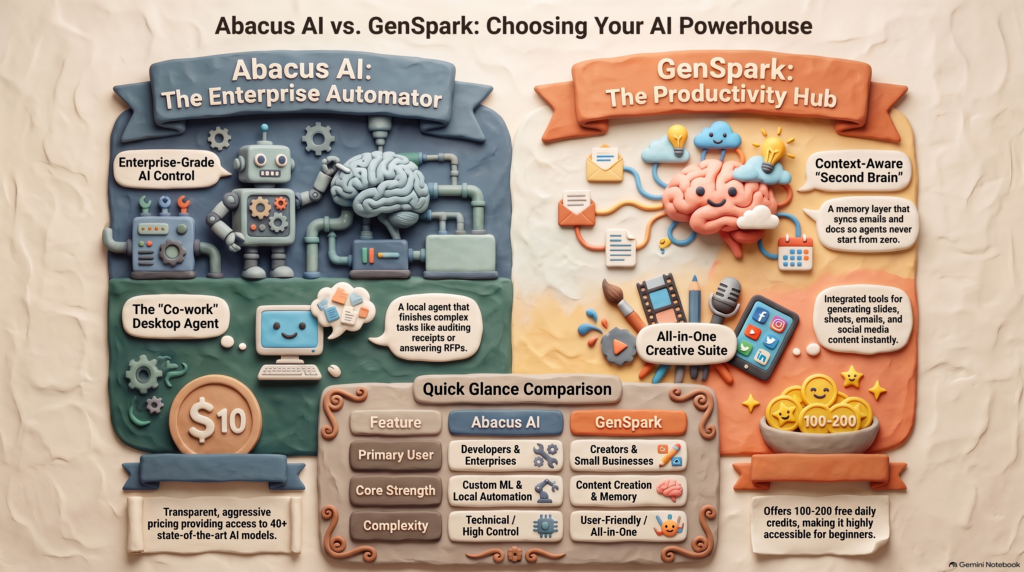
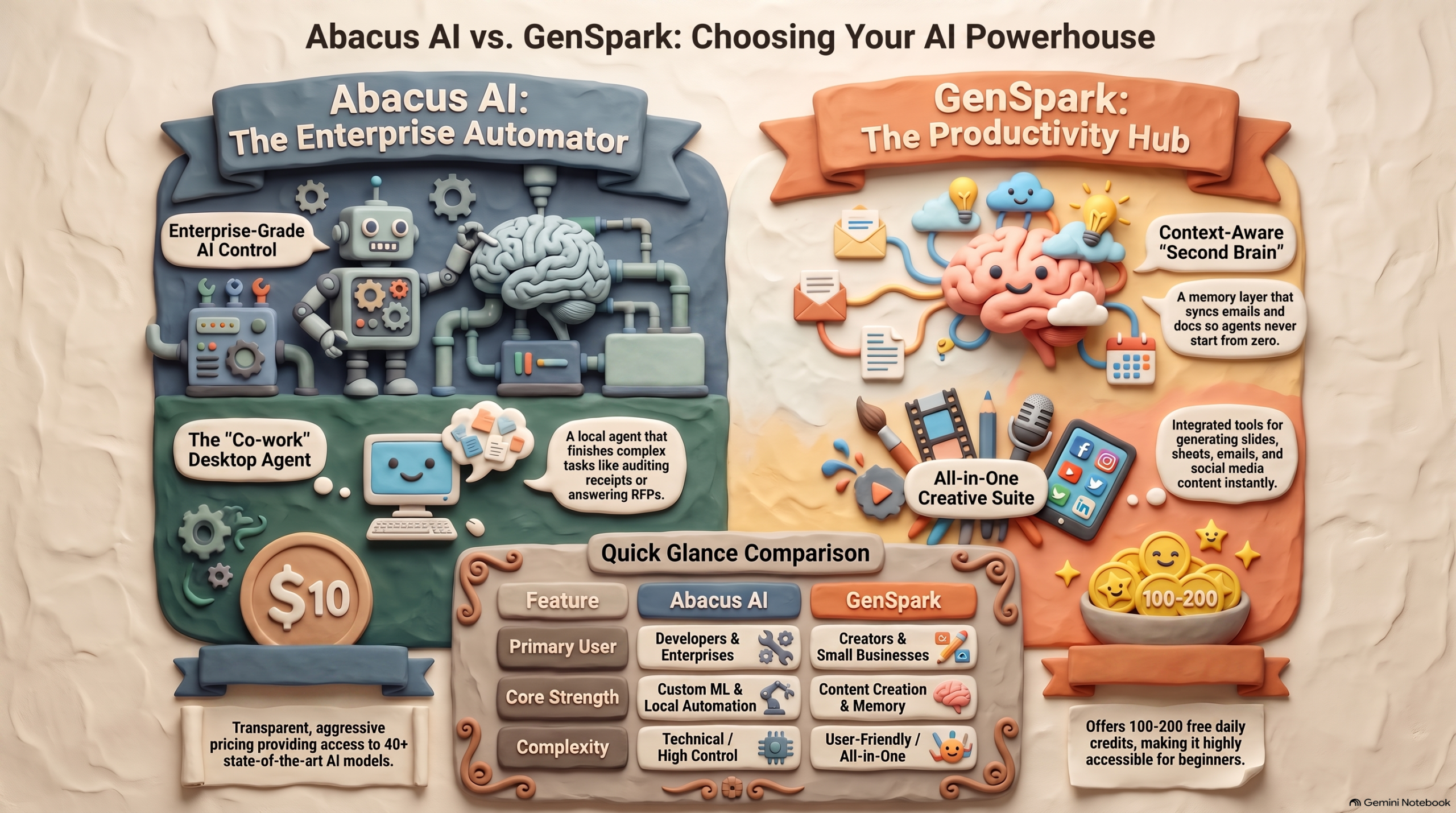
Genspark vs Abacus AI: A Strategic Comparison Report
1. Introduction: The Evolving AI Workspace Landscape
The enterprise technology landscape is currently witnessing a paradigm shift from fragmented, chat-based AI interfaces toward integrated AI workspaces and autonomous agentic platforms. This transition represents more than a tool upgrade; it is a fundamental re-engineering of how professional productivity is structured. As AI matures from a simple query-response mechanism into an orchestrator of complex workflows, selecting the correct infrastructure has become a strategic necessity for maintaining a competitive edge.
This report evaluates two market leaders that exemplify this shift: Abacus AI, an enterprise-grade MLOps and machine learning powerhouse designed for production-level depth, and Genspark, a collaborative AI workspace designed to unify professional workflows through persistent memory and context-aware agents. While both offer significant automation, their architectures serve vastly different operational intents and technical requirements.
2. Platform Philosophy and Target Audience Analysis
In my experience as an AI Solutions Architect, the success of any implementation hinges on “user-intent alignment.” Choosing between a developer-centric infrastructure and a creator-centric workspace is not merely a matter of features, but a decision on how much technical friction an organization is willing to tolerate in exchange for granular control.
- Target Audience Segments: Abacus AI is engineered for developers, data science teams, and “high-revenue founders” who require deep governance over machine learning pipelines and the ability to build custom, scalable applications. In contrast, Genspark targets creators, marketing professionals, and coaching/service providers who prioritize rapid execution and a unified user experience.
- Technical Barriers to Entry: Abacus AI demands a level of technical literacy to navigate its complex setup, though it compensates with developer-specific tools like a Command Line Interface (CLI) and a native Code Editor. Genspark lowers the barrier to entry through a no-code, “beginner-friendly” interface, allowing users to deploy “ready-made” AI tools and agentic workflows instantly without manual coding.
While Abacus AI facilitates the construction of custom AI systems, Genspark focuses on the seamless consumption and orchestration of AI to augment existing business routines.
3. Deep Dive: Abacus AI’s Technical Infrastructure
From an architectural perspective, Abacus AI’s value proposition lies in its “production-grade” reliability. For organizations where data security and model precision are paramount, the platform serves as a critical mitigation strategy for data leakage, particularly through its emphasis on local file processing.
Chat LLM
The Chat LLM interface serves as a unified gateway to over 40 state-of-the-art models, including the latest iterations from GPT, Claude, and Gemini. Beyond simple chat, it handles massive PDFs and enables the creation of RAG (Retrieval-Augmented Generation) chatbots that leverage proprietary organizational knowledge for high-accuracy internal support.
Abacus CoWork
Abacus CoWork is a specialized agent designed to “live on the desktop” and execute multi-step tasks rather than merely providing summaries. Because it operates directly on local files (Mac, Windows, and Linux) without mandatory cloud uploads, it provides a secure environment for sensitive workflows. High-impact use cases include:
- Audit Reporting: Transforming folders of disjointed receipts and budget sheets into polished, six-page audit reports with issue severity ratings.
- RFP Automation: Completing 100+ question compliance forms and security questionnaires with verified source citations in minutes.
- Engineering Post-Mortems: Aggregating Slack exports, application logs, and alert histories to reconstruct a minute-by-minute incident timeline and root-cause analysis.
Deep Agent
Deep Agent provides the platform’s advanced orchestration layer. It utilizes multi-agent parallelism, spinning up sub-agents that collaborate simultaneously to solve complex objectives faster than serial-processing systems. Its Model Context Protocol (MCP) integration is strategically vital; it bridges the “fragmented SaaS ecosystem” by allowing the AI to communicate across incompatible silos like Jira, Slack, and external CRMs. This enables the autonomous creation of Stripe-integrated websites, trading bots, and live dashboards from simple prompts.
4. Deep Dive: Genspark’s Collaborative Productivity Suite
Genspark 6.0 is structured as a four-layer ecosystem (Memory, Intelligence, Tools, and Team) designed to eliminate the high operational costs associated with context-switching.
Second Brain & Memory Layer
The Second Brain serves as a persistent memory layer that aggregates emails, calendar events, and documents into a “running context.” This ensures the AI never “starts from zero,” maintaining project-specific awareness across sessions. This layer is extended by the Second Brain Note, a card-thin physical AI recorder with a 35-hour recording capacity. It features a physical light indicator for transparent recording and syncs meetings directly into the searchable memory, allowing users to immediately generate slides or notes from a physical conversation.
Super Agent and Skills
The Super Agent orchestrates over 70 models to execute complex tasks. It excels in real-world actions, such as making autonomous phone calls to service providers (e.g., real estate agents) and providing full transcripts and summaries. A key architectural innovation is the “Skill” concept, which allows users to turn repetitive routines—like morning email sorting or status reporting—into reusable, automated workflows.
Integrated Productivity Suite
Genspark’s workspace includes a suite of no-code tools designed for rapid business output:
- Gen Mail: An AI email client that drafts replies in the user’s voice and provides briefings based on “Email Brain” history.
- Agent Base: A no-code environment for building custom dashboards, CRMs, and lead-gen tools that can rank on Google within 72 hours.
- Office Suite: Native AI tools for generating Slides, Sheets, and Docs. This enables workflows like the 8-week coaching program automation, where the AI handles client prep, session briefings, and follow-up emails within a single environment.
Gen Team
Gen Team introduces a collaborative layer where human team members and “agents that never sleep” share the same channels and context, effectively acting as an automated workforce within a familiar chat-based interface.
5. Comparative Analysis of Agentic Capabilities
The strategic differentiator between these platforms is the nature of their “agentic autonomy.”
- Execution Style: Abacus AI focuses on Multi-Agent Systems and high-depth enterprise integration. Its ability to find and use tools dynamically via MCP makes it superior for building complex, external-facing applications. It utilizes a parallel execution model that significantly outpaces serial-processing competitors in heavy-duty workflows.
- Accessibility & Speed: Genspark’s Super Agent is optimized for parallelization and rapid prototyping within a business context. While it lacks the low-level developer control of Abacus, its ability to synthesize creative content, perform web-based research, and execute real-world tasks (like calls and SEO ranking) makes it a more versatile “assistant” for non-technical users.
6. Operational Evaluation: Pros, Cons, and Ease of Use
Implementing these solutions requires weighing technical control against deployment velocity.
Abacus AI
- Pros: Production-grade scalability; local file processing (mitigates data leakage); SOC2 Type 2 and HIPAA compliance; deep technical control with CLI and Code Editor support.
- Cons: Steeper learning curve; higher technical setup requirement; no free-tier daily usage model.
Genspark
- Pros: Exceptional operational speed; no-code accessibility; 100–200 free daily credits; hardware integration for meeting capture; superior for “Skill”-based routine automation.
- Cons: Credit caps can limit high-volume users; less suitable for deep MLOps or low-level model tuning.
7. Pricing, Accessibility, and Security
Strategic adoption requires a clear understanding of TCO (Total Cost of Ownership) and data governance.
- Pricing: Abacus AI is priced at $10/user/month (with a $7 introductory first month), providing an aggressive entry point for enterprise tools. Genspark utilizes a tiered “Plus” model, generally ranging from $19.99 to $24.99/month, with higher-tier plans reaching $39.99+ for expanded credit limits (e.g., 125,000+ credits).
- Security: Abacus AI is SOC2 Type 2 and HIPAA compliant, making it the standard for healthcare and financial data. Genspark holds SOC2 Type 2 and ISO271 certifications, providing high-level encryption suitable for general business and creative operations.
8. Feature Correlation Table
Strategic Comparison: Genspark vs. Abacus AI
| Feature/Metric | Genspark | Abacus AI |
|---|---|---|
| Primary Focus | Unified Workspace & CRM Automation | Machine Learning & Production MLOps |
| Target User | Creators, Marketers, Ops Managers | Developers, DevOps, Data Teams |
| Core Agentic Tool | Super Agent (with Phone Calling) | Deep Agent / CoWork (with Desktop App) |
| Developer Tools | No-code “Agent Base” | CLI, Code Editor, API Management |
| Hardware Integration | Second Brain Note (35hr Capacity) | None |
| Connectivity | 70+ Models; Internal Office Suite | MCP (Jira, Slack, CRM) Integration |
| Security Standards | SOC2 Type 2, ISO271 | SOC2 Type 2, HIPAA |
| Pricing Model | 200 Free Daily Credits; $19.99 – $39.99+/mo | $10/user/mo ($7 Intro Month) |
9. Conclusion and Strategic Recommendation
The decision between Abacus AI and Genspark is determined by whether your organization needs to build AI infrastructure or leverage a pre-built AI workforce.
Decision Framework
- Recommend Abacus AI for: Engineering and DevOps leaders who must manage complex data pipelines, maintain high compliance (HIPAA), or reconstruct technical incidents. It is the definitive choice for businesses needing production-grade automation that handles sensitive files locally.
- Recommend Genspark for: Marketing teams, creators, and service businesses focused on “Content Pipeline Automation” and “Client Relationship Management.” Its ability to automate an entire 8-week coaching program or rank lead-gen tools on Google in 72 hours makes it the superior choice for rapid operational growth without technical overhead.
For the modern professional seeking an immediate, “all-in-one” productivity teammate, Genspark provides the fastest ROI. However, for the enterprise seeking to bake AI into the core of its technical stack, Abacus AI remains the architect’s choice.thumb_upGood report thumb_downBad report